Archive
Carnactic Song Band Asaf Sirkis
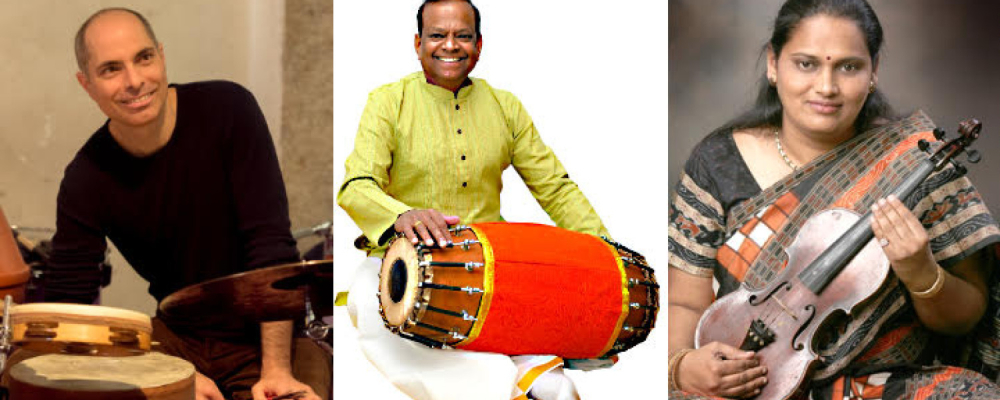
Asaf has been a student and performer of Carnactic song, under the tutelage of Kirupakaran. In this special performance Asaf brings his love of the genre along with his favourite south Indian musicians for a set of improvised songs. Carnatic music is the classical music tradition of South India, known for its spiritual roots, intricate melodies (ragas), complex rhythmic cycles (talas), and emphasis on vocal expression, incorporating subtle microtonal nuances and rich devotional compositions that blend structured frameworks with deep improvisation.
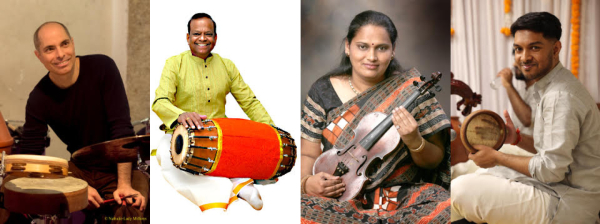
Line Up: Asaf Sirkis – drums, Jyotsna Srikanth (MBE) - Carnatic violin, Acharya Ratna Sri P. Kirupakaran – Mridangam (double headed drum), Kajan Kugendran - Khanjira & Ruchira Sharma guest singer

Key Carnactic Characteristics
- Vocal Emphasis: Most compositions are written to be sung, with instrumental music often mimicking the human voice.
- Raga & Tala: The core framework relies on specific melodic patterns (ragas) and rhythmic cycles (talas) for improvisation and composition.
- Spiritual Context: Deeply connected to Hindu devotional practices, serving as a medium for expressing devotion to the divine.
- Improvisation: A significant aspect, allowing musicians to creatively interpret the melodic and rhythmic structures.
- Compositions: Often devotional songs (kritis) with structured sections like pallavi, anupallavi, and charanam.
Core Elements
- Svara: The seven musical notes (Sa, Ri, Ga, Ma, Pa, Dha, Ni) forming the building blocks.
- Raga: Melodic frameworks or modes that define the mood and rules for improvisation.
- Tala: Cyclical rhythmic patterns that structure the music.
- Shruti: The relative musical pitch, establishing the tonal base.
Instruments
Common instruments include:
- Vocals (Voice)
- Mridangam (double-headed drum)
- Veena (plucked string instrument)
- Violin (adapted to Carnatic style)
- Ghatam (clay pot)
- Kanjira (frame drum)
- Tanpura (drone instrument)